- Overview
- What is TEC Certification?
- What is the MTCTE Scheme?
- Types of TEC Certification
- Products Covered Under MTCTE Scheme
- MTCTE Mandatory TEC Certification
- Voluntary TEC Certification
- Voluntary Security Certification
- CAS/SMS Certification
- Documents Required
- Why Choose SS Global Services
- Frequently Asked Questions (FAQ)
Overview
If you want to sell or import telecom equipment in India, obtaining a certificate from the Telecommunication Engineering Centre (TEC) is mandatory. This requirement applies to both Original Equipment Manufacturers (OEMs) and their Authorized Indian Representatives (AIRs).
TEC provides different types of certifications depending on the product category. The most important one is MTCTE (Mandatory Testing and Certification of Telecom Equipment), which is compulsory for products officially notified by TEC. For products that are not yet included under the MTCTE list, a voluntary certification option is available. In some cases, especially where network security is involved, ITSAR-based security certification is also required.
The certification process begins with submitting an application on the TEC portal along with essential documents such as company registration details, MoU (for foreign OEMs), product specifications, and bill of materials. The product is then tested in a TEC-approved laboratory. Once all requirements are successfully met, TEC issues the certificate, allowing the product to be legally sold or imported in India.
This certification not only ensures legal compliance but also builds confidence among telecom operators, distributors, and end users. It reflects that your product meets India’s technical and safety standards, helping you enter the market with credibility and avoid regulatory risks or disruptions.
At SS Global Services, we make the TEC/MTCTE Certification process smooth and stress-free by providing expert guidance and complete end-to-end support. Our experienced compliance team helps businesses secure approvals quickly, ensuring minimal delays, accurate documentation, and complete transparency throughout the process.
Get TEC CertificationWhat is TEC Certification?
TEC Certification is a mandatory requirement for telecom equipment in India to ensure that the products meet the technical standards set by the government. It is issued by the Telecommunication Engineering Centre (TEC), which works under the Department of Telecommunications (DoT). This certification ensures that telecom devices being used in the country are safe, reliable, and suitable for real-world network conditions.
TEC is responsible for defining technical standards and guiding the controlled introduction of new telecom technologies in India. Under the MTCTE (Mandatory Testing and Certification of Telecom Equipment) scheme, products are tested in approved laboratories before they are allowed in the market. Only after the equipment passes all required tests and compliance checks does TEC grant the certification.
This process helps prevent low-quality or unsafe equipment from entering telecom networks. It also gives confidence to service providers and users that the equipment meets national standards and supports the overall stability and security of India’s communication infrastructure.
Importance of TEC Certification
TEC certification is important because it ensures that all telecom equipment used in India is safe, reliable, and compliant with government standards. By making testing and certification mandatory, it protects consumers from poor-quality or unsafe devices and helps maintain the smooth functioning of telecom networks. It also promotes cybersecurity and data protection, since equipment is checked for both technical and security requirements.
For manufacturers, having TEC certification builds trust with customers, supports participation in government tenders, and makes it easier to introduce new technologies in the Indian market. Overall, TEC certification safeguards the interests of users, strengthens the telecom ecosystem, and helps keep India’s communications infrastructure secure and efficient.
TEC certification is a cornerstone of India’s telecommunications framework, designed to ensure that every telecom product complies with the required safety and technical benchmarks. Its importance can be understood in several ways:
- Quality Assurance:
Certification guarantees that telecom devices deliver reliable performance and meet defined quality levels, which is vital for smooth communication services.
- Safety Compliance:
Equipment undergoes strict testing to eliminate safety risks, safeguarding both users and the overall telecom infrastructure.
- Regulatory Requirement:
As a mandatory process under the Department of Telecommunications (DoT), TEC certification ensures that only approved and compliant products are available in the market.
- Consumer Trust:
Certified devices give end-users confidence in the safety, durability, and efficiency of the products they use.
- Market Eligibility:
For manufacturers, TEC approval is essential to sell or import telecom equipment in India, making it the gateway to the Indian telecom market.
- Support for Innovation:
By enforcing standardization while allowing room for new technologies, TEC certification provides a structured pathway for innovation in the telecom sector.
In essence, TEC certification not only protects consumers but also supports manufacturers, strengthens market discipline, and contributes to a secure and high-quality telecom ecosystem in India.
Start TEC CertificationWhat is the MTCTE Scheme?
The Mandatory Testing and Certification of Telecom Equipment (MTCTE) scheme is a regulatory initiative introduced by the Department of Telecommunications (DoT), Government of India. Its purpose is to ensure that all telecom equipment used within the country adheres to defined technical and safety standards. As per the Indian Telegraph (Amendment) Rules, 2017, no telecom device can be sold, imported, or operated in India unless it has been tested and certified.
The testing is carried out by Indian Accredited Laboratories that are designated by the Telecommunication Engineering Centre (TEC). These labs verify whether the equipment complies with the Essential Requirements (ERs). Based on their reports, TEC issues the certificate of approval. The scheme is aimed at protecting telecom networks from performance issues, while ensuring reliability, security, and safety for end users.
The scope of MTCTE includes a wide range of telecom products such as mobile handsets, routers, base stations, switches, and network equipment. Any device capable of connecting to the public telecom network must go through this certification. The evaluation covers key aspects such as electromagnetic compatibility (EMC), safety, technical performance, and Specific Absorption Rate (SAR) for mobile phones. Compliance with MTCTE is compulsory for manufacturers and importers, and failure to comply may lead to penalties, fines, and restrictions on the sale or usage of uncertified equipment in India.
Types of TEC certification Schemes
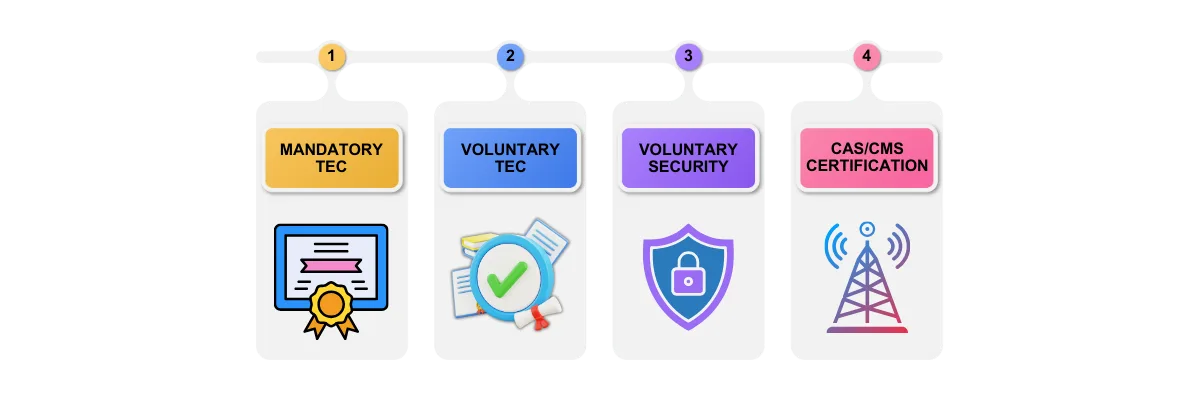
The MTCTE scheme includes different types of TEC certifications, each catering to various compliance and safety requirements for telecom equipment. Some major type of TEC Certification are as follows:
- 1. MANDATORY TEC CERTIFICATION (MTCTE)
- 2. VOLUNTARY TEC CERTIFICATION
- 3. VOLUNTARY SECURITY CERTIFICATION (NCCS)
- 4. CAS/SMS CERTIFICATION
1. Mandatory TEC Certification (MTCTE)
Mandatory Testing and Certification of Telecom Equipment (MTCTE) certification is required to ensure telecom equipment meets TEC Essential Requirements (ERs). It can be obtained through either the General Certification Scheme (GCS) or the Simplified Certification Scheme (SCS).
The process involves compliance checks, testing, and submission of necessary documents before TEC issues the certificate.
1. General Certification Scheme (GCS):
- Applicant must submit test reports, compliance summary, and relevant certificates.
- Testing is done as per Essential Requirements (ERs) in a recognized lab (CAB or approved foreign lab).
- Certification process usually takes about 40–45 working days.
2. Simplified Certification Scheme (SCS):
- Applicant needs to test the product as per ERs and submit a compliance checklist with a Self-Declaration of Conformity (S-DoC).
- Detailed reports are not required at the time of application, but TEC may request them later.
- Certification is faster, usually 15–20 working days.
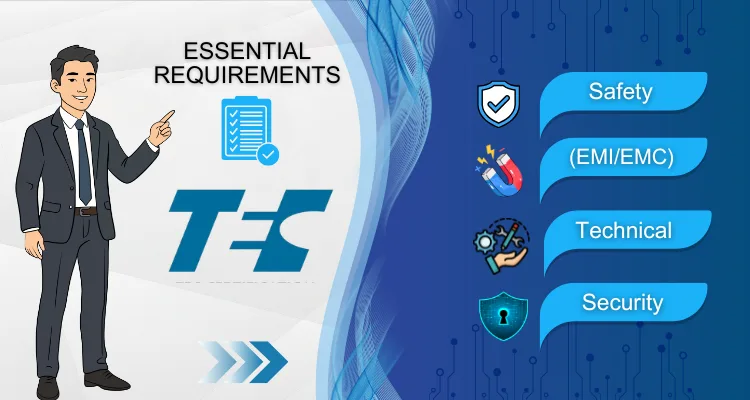
The Essential Requirements (ERs) include the following:
- Safety: The equipment must be designed and manufactured to ensure safe operation for users and connected networks under normal and foreseeable conditions.
- Electromagnetic Interference (EMI) / Electromagnetic Compatibility (EMC): The equipment must not generate electromagnetic interference and must function correctly without being affected by interference from other devices.
- Technical Requirements: The equipment must comply with defined technical and performance standards, including wireless and radio frequency (RF) parameters specified by applicable regulations.
- Security: The equipment must meet security requirements as notified by the Department of Telecommunications (DoT) to ensure protection against unauthorized access, data breaches, and cyber threats.
MTCTE Mandatory TEC Certification Process
Step 1: Register on MTCTE Portal
- Create an account on the official MTCTE website.
- The applicant (Indian manufacturer, trader, or authorized representative of a foreign OEM) must provide company details such as PAN, registration certificate, and authorization letter.
- If the product is imported, factory details of the foreign OEM along with an Indian representative must also be registered.
Step 2: Choose Product & Interfaces
- Select the correct product category and model variants from the portal.
- Declare all the interfaces (e.g., LTE, Wi-Fi, Bluetooth, SIM, etc.).
- Upload the Bill of Materials (BoM) in the required format.
- The system will automatically map the product to relevant Essential Requirements (ERs) and show the applicable certification scheme and fees.
Step 3: BoM Review
- TEC officers examine the submitted BoM.
- If anything is missing or unclear, they request clarifications before approval.
Step 4: Payment of Fees
- Once BoM is cleared, pay the applicable testing and certification charges online through the MTCTE portal.
Step 5: Product Testing at Lab
- Provide product samples to a TEC-designated Conformity Assessment Body (CAB) or recognized laboratory.
- The equipment is tested as per EMI/EMC, Safety, and Radio/Technical requirements specified in the ERs.
Step 6: Uploading Test Reports
- The laboratory uploads the finalized test reports onto the MTCTE portal.
- Applicant verifies and confirms submission.
Step 7: Document Verification
- TEC officials check all documents and reports.
- In case of any gaps, TEC raises queries which the applicant must address with additional documents or corrections.
Step 8: Certification Grant
- After successful evaluation, TEC issues the MTCTE certificate confirming compliance.
- This certificate is generally valid for five years unless product specifications or notified requirements change.

Basic Documents Required for Mandatory MTCTE/TEC Certification
For Indian Applicant Registration/ Indian OEM Registration:
- Certificate of Incorporation of Indian Applicant Company
- Pan Card of the Indian Applicant Company
- MOA, AOA and Shareholding Pattern
- Authorized Signatory Name and Designation
- Email address of the Authorized Signatory
- Phone Number of the Authorized Signatory
- Authorization Letter from the Director of Applicant Company in the name of Authorized signatory (Annexure 1)
- Product complete Data Sheet
For Foreign OEM Registration (If applicable):
- MOU between Foreign OEM and Indian Applicant (AIR) (Annexure 3)
- Name and address of the factories where the product will be manufactured
- AIR Authorization Letter for Indian Applicant (Annexure 2)
- Contact person Name and Designation of Foreign OEM
- Email ID of Contact Person of Foreign OEM
- Phone Number of Foreign OEM
List of Telecom products notified under MTCTE
| Sr No. | Essential Requirement / Product Name | Product Variant Name | MTCTE Phase | Mandatory Date of Certification |
|---|---|---|---|---|
| 1 | 2- Wire Telephone Equipment | 2-Line Feature Phone | Phase-1 | 1st October, 2019 |
| 2 | 2- Wire Telephone Equipment | CLIP (Calling Line Identification Presentation) Phone | Phase-1 | 1st October, 2019 |
| 3 | 2- Wire Telephone Equipment | Coin Box Telephone | Phase-1 | 1st October, 2019 |
| 4 | 2- Wire Telephone Equipment | Coin Box Telephone - Table Top Interface | Phase-1 | 1st October, 2019 |
| 5 | 2- Wire Telephone Equipment | Electronic Telephone Instrument | Phase-1 | 1st October, 2019 |
| 6 | 2- Wire Telephone Equipment | Executive Telephone Systems | Phase-1 | 1st October, 2019 |
| 7 | 2- Wire Telephone Equipment | Key Telephone Systems | Phase-1 | 1st October, 2019 |
| 8 | 2- Wire Telephone Equipment | Key Telephone Systems with proprietary interface | Phase-1 | 1st October, 2019 |
| 9 | 2- Wire Telephone Equipment | NSD (National Subscriber Dialing) or ISD (International Subscriber Dialing) Payphone | Phase-1 | 1st October, 2019 |
| 10 | 2- Wire Telephone Equipment | Terminals for connecting to PSTN (Public Switched Telephone Network) | Phase-1 | 1st October, 2019 |
| 11 | G3 Fax Machine | FAX machine with handset | Phase-1 | 1st October, 2019 |
| 12 | G3 Fax Machine | FAX machine without handset | Phase-1 | 1st October, 2019 |
| 13 | Modem | V.90 or V.92 or V.21 to V.34 Modem | Phase-1 | 1st October, 2019 |
| 14 | Cordless Telephone | Cordless Telephone | Phase-1 | 1st October, 2019 |
| 15 | ISDN (Integrated Services Digital Network) Customer Premises Equipment | ISDN Gateway | Phase-1 | 1st October, 2019 |
| 16 | ISDN (Integrated Services Digital Network) Customer Premises Equipment | ISDN NT-1 Network Termination | Phase-1 | 1st October, 2019 |
| 17 | ISDN (Integrated Services Digital Network) Customer Premises Equipment | ISDN Terminal | Phase-1 | 1st October, 2019 |
| 18 | ISDN (Integrated Services Digital Network) Customer Premises Equipment | ISDN Terminal Adapter | Phase-1 | 1st October, 2019 |
| 19 | ISDN (Integrated Services Digital Network) Customer Premises Equipment | Multipoint Conferencing Server | Phase-1 | 1st October, 2019 |
| 20 | ISDN (Integrated Services Digital Network) Customer Premises Equipment | PC card based ISDN Terminal | Phase-1 | 1st October, 2019 |
| 21 | Private Automatic Branch Exchange | Private Automatic Branch Exchange | Phase-1 | 1st October, 2019 |
| 22 | PON (Passive Optical Network) Family of Broadband Equipment | PON OLT (Optical Line Terminal) | Phase-2 | 1st October, 2020 |
| 23 | PON (Passive Optical Network) Family of Broadband Equipment | PON ONT (Optical Network Terminal) | Phase-2 | 1st October, 2020 |
| 24 | PON (Passive Optical Network) Family of Broadband Equipment | PON ONU (Optical Network Unit) | Phase-2 | 1st October, 2020 |
| 25 | Feedback Device | Feedback Device | Phase-2 | 1st October, 2020 |
| 26 | Transmission Terminal Equipment-1 | Multiplexing Equipment | Phase-2 | 1st October, 2020 |
| 27 | Transmission Terminal Equipment-1 | SDH (Synchronous Digital Hierarchy) Equipment | Phase-2 | 1st October, 2020 |
| 28 | Equipments Operating in 2.4 GHz and 5 GHz Band | PTP PMP Wireless Access Equipment 2.4 or 5 GHz | Phase-3 | 1st January, 2024 |
| 29 | Equipments Operating in 2.4 GHz and 5 GHz Band | Wifi Access Points and CPE (Customer Premises Equipment) | Phase-3 | 1st January, 2024 |
| 30 | Equipments Operating in 2.4 GHz and 5 GHz Band | WLAN Controller Equipment | Phase-3 | 1st January, 2024 |
| 31 | End Point Device for Environmental Monitoring | End Point Device for Environmental Monitoring | Phase-3 | 1st January, 2024 |
| 32 | Repeater for Cellular Network | GSM and WCDMA Repeater | Phase-3 | 1st April, 2024 |
| 33 | Repeater for Cellular Network | GSM Repeater | Phase-3 | 1st April, 2024 |
| 34 | Repeater for Cellular Network | GSM WCDMA and LTE Repeater | Phase-3 | 1st April, 2024 |
| 35 | Repeater for Cellular Network | LTE (Long Term Evolution) Repeater | Phase-3 | 1st April, 2024 |
| 36 | Repeater for Cellular Network | WCDMA (Wideband Code Division Multiple Access) and LTE Repeater | Phase-3 | 1st April, 2024 |
| 37 | Repeater for Cellular Network | WCDMA (Wideband Code Division Multiple Access) Repeater | Phase-3 | 1st April, 2024 |
| 38 | Base Station for Cellular Network | BTS (Base Transceiver Station ) for GSM (Global System for Mobile Communication) | Phase-3 | 1st August, 2024 |
| 39 | Base Station for Cellular Network | BTS with AAS (Advanced Antenna Systems) | Phase-3 | 1st August, 2024 |
| 40 | Base Station for Cellular Network | BTS with MSR (Multi-Standard Radio) up to 4G | Phase-3 | 1st August, 2024 |
| 41 | Base Station for Cellular Network | eNodeB for LTE (Long Term Evolution) | Phase-3 | 1st August, 2024 |
| 42 | Base Station for Cellular Network | NodeB for WCDMA | Phase-3 | 1st August, 2024 |
| 43 | Compact Cellular Network | BTS CCN | Phase-3 | 1st January, 2024 |
| 44 | Compact Cellular Network | eNodeB CCN | Phase-3 | 1st January, 2024 |
| 45 | Compact Cellular Network | NodeB CCN | Phase-3 | 1st January, 2024 |
| 46 | IoT (Internet of Things) Gateway | IoT Gateway | Phase-3 | 1st January, 2024 |
| 47 | Tracking Device | Asset Tracking Device | Phase-3 | 1st January, 2024 |
| 48 | Tracking Device | Human Tracking Device | Phase-3 | 1st January, 2024 |
| 49 | Tracking Device | Pet Tracking Device | Phase-3 | 1st January, 2024 |
| 50 | Tracking Device | Standalone tracking device for Vehicle | Phase-3 | 1st January, 2024 |
| 51 | Smart Electricity Meter | Smart Electricity Meter | Phase-3 | 1st October, 2024 |
| 52 | Mobile Radio Trunking System | MRTS Base Station - Baseband plus Radio | Phase-4 | 1st August, 2024 |
| 53 | Mobile Radio Trunking System | MRTS Base Station - Radio Only | Phase-4 | 1st August, 2024 |
| 54 | Mobile Radio Trunking System | MRTS Baseband Equipment without Radio | Phase-4 | 1st August, 2024 |
| 55 | Mobile Radio Trunking System | MRTS Fixed Station | Phase-4 | 1st August, 2024 |
| 56 | Mobile Radio Trunking System | MRTS Handheld Portable Station | Phase-4 | 1st August, 2024 |
| 57 | Mobile Radio Trunking System | MRTS Mobile Station | Phase-4 | 1st August, 2024 |
| 58 | Conferencing Equipment | Audio Conference Facility Device | Phase-4 | 1st January, 2024 |
| 59 | Conferencing Equipment | Multi Line Telephone System | Phase-4 | 1st January, 2024 |
| 60 | HF (High Frequency) Radio | HF Base Station - Baseband plus Radio | Phase-4 | 1st April, 2024 |
| 61 | HF (High Frequency) Radio | HF Base Station - Radio Only | Phase-4 | 1st April, 2024 |
| 62 | HF (High Frequency) Radio | HF Baseband Equipment without Radio | Phase-4 | 1st April, 2024 |
| 63 | HF (High Frequency) Radio | HF Fixed Station | Phase-4 | 1st April, 2024 |
| 64 | HF (High Frequency) Radio | HF Handheld Portable Stations | Phase-4 | 1st April, 2024 |
| 65 | HF (High Frequency) Radio | HF Mobile Stations | Phase-4 | 1st April, 2024 |
| 66 | VHF (Very High Frequency) UHF (Ultra High Frequency) Radio System Equipment | VHF UHF Base Station - Baseband plus Radio | Phase-4 | 1st August, 2024 |
| 67 | VHF (Very High Frequency) UHF (Ultra High Frequency) Radio System Equipment | VHF UHF Base Station - Radio Only | Phase-4 | 1st August, 2024 |
| 68 | VHF (Very High Frequency) UHF (Ultra High Frequency) Radio System Equipment | VHF UHF Baseband Equipment without Radio | Phase-4 | 1st August, 2024 |
| 69 | VHF (Very High Frequency) UHF (Ultra High Frequency) Radio System Equipment | VHF UHF Fixed Station | Phase-4 | 1st August, 2024 |
| 70 | VHF (Very High Frequency) UHF (Ultra High Frequency) Radio System Equipment | VHF UHF Handheld Portable Stations | Phase-4 | 1st August, 2024 |
| 71 | VHF (Very High Frequency) UHF (Ultra High Frequency) Radio System Equipment | VHF UHF Mobile Stations | Phase-4 | 1st August, 2024 |
| 72 | PTP (Point to Point) PMP (Point to Multi Point) Microwave Fixed Radio Systems | PTP or PMP Full Outdoor Microwave Systems | Phase-4 | 1st August, 2024 |
| 73 | PTP (Point to Point) PMP (Point to Multi Point) Microwave Fixed Radio Systems | PTP or PMP Split MW Indoor Unit | Phase-4 | 1st August, 2024 |
| 74 | PTP (Point to Point) PMP (Point to Multi Point) Microwave Fixed Radio Systems | PTP or PMP Split MW Outdoor Unit | Phase-4 | 1st August, 2024 |
| 75 | PTP (Point to Point) PMP (Point to Multi Point) Microwave Fixed Radio Systems | PTP/PMP Split MW System | Phase-4 | 1st August, 2024 |
| 76 | Media Gateway | Line Media Gateway | Phase-4 | 1st January, 2024 |
| 77 | Media Gateway | Media Gateway | Phase-4 | 1st January, 2024 |
| 78 | Media Gateway | Media Gateway for CPE | Phase-4 | 1st January, 2024 |
| 79 | Signalling Gateway | Signalling Gateway | Phase-4 | 1st January, 2024 |
| 80 | Session Border Controller | Session Border Controller | Phase-4 | 1st January, 2024 |
| 81 | Softswitch | Softswitch | Phase-4 | 1st January, 2024 |
| 82 | DSL (Digital Subscriber Line) Equipments | DSLAM | Phase-4 | 1st January, 2024 |
| 83 | DSL (Digital Subscriber Line) Equipments | DSL Modem | Phase-4 | 1st January, 2024 |
| 84 | Satellite Communication Equipment | Satellite Amplifier | Phase-4 | 1st October, 2024 |
| 85 | Satellite Communication Equipment | Satellite Baseband Mod or Demod or Controller | Phase-4 | 1st October, 2024 |
| 86 | Satellite Communication Equipment | Satellite Baseband Modem | Phase-4 | 1st October, 2024 |
| 87 | Satellite Communication Equipment | Satellite Baseband Modem Controller | Phase-4 | 1st October, 2024 |
| 88 | Satellite Communication Equipment | Satellite BUC (Block Up Converter) | Phase-4 | 1st October, 2024 |
| 89 | Satellite Communication Equipment | Satellite IF Transreceiver | Phase-4 | 1st October, 2024 |
| 90 | Satellite Communication Equipment | Satellite LNA (Low Noise Amplifier) | Phase-4 | 1st October, 2024 |
| 91 | Satellite Communication Equipment | Satellite LNB (Low Noise Block downconverter) | Phase-4 | 1st October, 2024 |
| 92 | Satellite Communication Equipment | Satellite Optimisation Equipment | Phase-4 | 1st October, 2024 |
| 93 | Satellite Communication Equipment | Satellite Radio Frequency Transceiver | Phase-4 | 1st October, 2024 |
| 94 | Satellite Communication Equipment | VSAT (Very Small Aperture Terminal) Terminals | Phase-4 | 1st October, 2024 |
| 95 | LAN (Local Area Network) Switch | L2 LAN Switch | Phase-4 | 1st August, 2024 |
| 96 | LAN (Local Area Network) Switch | L3 LAN Switch | Phase-4 | 1st August, 2024 |
| 97 | LAN (Local Area Network) Switch | MPLS (Multiprotocol Label Switching) TP (Transport Profile) CEN (Carrier Ethernet Network) Switch | Phase-4 | 1st August, 2024 |
| 98 | LAN (Local Area Network) Switch | L2 Unmanaged Switch | Phase-4 | 1st August, 2024 |
| 99 | Router | BNG (Broadband Network Gateway) or BRAS (Broadband Remote Access Server) Router | Phase-4 | 1st August, 2024 |
| 100 | Router | Cloud Control Capable Router | Phase-4 | 1st August, 2024 |
| 101 | Router | IPV4 (Internet Protocol v4) Router | Phase-4 | 1st August, 2024 |
| 102 | Router | IPV6 (Internet Protocol v6) Router | Phase-4 | 1st August, 2024 |
| 103 | Router | MPLS (Multiprotocol Label Switching) Router | Phase-4 | 1st August, 2024 |
| 104 | Transmission Terminal Equipment-2 | DWDM (Dense wavelength-division multiplexing) Equipment | Phase-4 | 1st January, 2024 |
| 105 | Transmission Terminal Equipment-2 | Digital Cross Connect | Phase-4 | 1st January, 2024 |
| 106 | IP (Internet Protocol) Security Equipment | Firewall Equipment | Phase-4 | 1st August, 2024 |
| 107 | IP (Internet Protocol) Security Equipment | Intrusion Detection System Equipment | Phase-4 | 1st August, 2024 |
| 108 | IP (Internet Protocol) Security Equipment | Intrusion Prevention System Equipment | Phase-4 | 1st August, 2024 |
| 109 | IP (Internet Protocol) Security Equipment | Unified Threat Management Equipment | Phase-4 | 1st August, 2024 |
| 110 | Precision Timing Protocol Grand Master Equipment | Precision Timing Protocol Grand Master Equipment | Phase-4 | 1st January, 2024 |
| 111 | Mobile Management Entity | MME with connectivity to MSC SGSN | Phase-4 | 1st January, 2024 |
| 112 | Mobile Management Entity | MME for LTE | Phase-4 | 1st January, 2024 |
| 113 | Cell Broadcast Centre | CBC for GSM | Phase-4 | 1st January, 2024 |
| 114 | Cell Broadcast Centre | CBC for LTE or LTE-A | Phase-4 | 1st January, 2024 |
| 115 | Cell Broadcast Centre | CBC For UMTS | Phase-4 | 1st January, 2024 |
| 116 | IP Multimedia Conferencing Equipment | IP Multimedia Conferencing Equipment | Phase-4 | 1st January, 2024 |
| 117 | BSC (Base Station Control) RNC (Radio Network Controller) | BSC for GSM | Phase-4 | 1st January, 2024 |
| 118 | BSC (Base Station Control) RNC (Radio Network Controller) | RNC for WCDMA | Phase-4 | 1st January, 2024 |
| 119 | SMLC (Serving Mobile Location Center) or eSMLC (Evolved Serving Mobile Location Center) | eSMLC for LTE | Phase-4 | 1st January, 2024 |
| 120 | SMLC (Serving Mobile Location Center) or eSMLC (Evolved Serving Mobile Location Center) | SMLC for GSM | Phase-4 | 1st January, 2024 |
| 121 | SMLC (Serving Mobile Location Center) or eSMLC (Evolved Serving Mobile Location Center) | SMLC for WCDMA | Phase-4 | 1st January, 2024 |
| 122 | SGSN (Serving GPRS Support Node) or GGSN (Gateway GPRS Support Node) | GGSN | Phase-4 | 1st January, 2024 |
| 123 | SGSN (Serving GPRS Support Node) or GGSN (Gateway GPRS Support Node) | SGSN For GSM | Phase-4 | 1st January, 2024 |
| 124 | SGSN (Serving GPRS Support Node) or GGSN (Gateway GPRS Support Node) | SGSN For LTE | Phase-4 | 1st January, 2024 |
| 125 | SGSN (Serving GPRS Support Node) or GGSN (Gateway GPRS Support Node) | SGSN For WCDMA | Phase-4 | 1st January, 2024 |
| 126 | HLR (Home Location Register) AUC (Authentication Centre) HSS (Home Subscriber Server) | HLR or AUC | Phase-4 | 1st January, 2024 |
| 127 | HLR (Home Location Register) AUC (Authentication Centre) HSS (Home Subscriber Server) | HSS | Phase-4 | 1st January, 2024 |
| 128 | MSC or MSC-S or GMSC or GMSC-S including VLR | MSC-S or GMSC-S | Phase-4 | 1st January, 2024 |
| 129 | MSC or MSC-S or GMSC or GMSC-S including VLR | MSC or GMSC including VLR for GSM | Phase-4 | 1st January, 2024 |
| 130 | MSC or MSC-S or GMSC or GMSC-S including VLR | MSC or GMSC including VLR for WCDMA | Phase-4 | 1st January, 2024 |
| 131 | Infiniband Switch | Infiniband Switch | Phase-4 | 1st January, 2024 |
| 132 | OTA (Over-The-Air) and DM (Device Manager) or FOTA (Firmware Over-The-Air) | DM or FOTA | Phase-4 | 1st January, 2024 |
| 133 | OTA (Over-The-Air) and DM (Device Manager) or FOTA (Firmware Over-The-Air) | OTA | Phase-4 | 1st January, 2024 |
| 134 | SCP (Service Control Point) | SCP | Phase-4 | 1st January, 2024 |
| 135 | OMC (Operations and Maintenance Center) or EMS (Element Management Systems) or NMS (Network Management Systems) or OSS (Operations Support System) | NMS | Phase-4 | 1st January, 2024 |
| 136 | OMC (Operations and Maintenance Center) or EMS (Element Management Systems) or NMS (Network Management Systems) or OSS (Operations Support System) | OMC or EMS | Phase-4 | 1st January, 2024 |
| 137 | S-GW (Serving Gateway) or P-GW (Packet Data Network Gateway) | P-Gateway | Phase-4 | 1st January, 2024 |
| 138 | S-GW (Serving Gateway) or P-GW (Packet Data Network Gateway) | S-Gateway | Phase-4 | 1st January, 2024 |
| 139 | SMSC (Short Message Service Center) | SMSC | Phase-4 | 1st January, 2024 |
| 140 | GMLC (Gateway Mobile Location Centre) | GMLC for GSM or WCDMA | Phase-4 | 1st January, 2024 |
| 141 | GMLC (Gateway Mobile Location Centre) | GMLC for LTE or LTE-A | Phase-4 | 1st January, 2024 |
| 142 | EIR (Equipment Identity Register) | EIR for GSM or WCDMA | Phase-4 | 1st January, 2024 |
| 143 | EIR (Equipment Identity Register) | EIR for LTE | Phase-4 | 1st January, 2024 |
| 144 | Optical Fibre Cable | Hybrid Cable - Optical and Metallic | Phase-4 | 1st January, 2024 |
| 145 | Optical Fibre Cable | Optical Fibre Cable - ADSS on Aerial alignment | Phase-4 | 1st January, 2024 |
| 146 | Optical Fibre Cable | Optical Fibre Cable - ADSS along Power line | Phase-4 | 1st January, 2024 |
| 147 | Optical Fibre Cable | Optical Fibre Cable - Direct Buried | Phase-4 | 1st January, 2024 |
| 148 | Optical Fibre Cable | Optical Fibre Cable - DSA | Phase-4 | 1st January, 2024 |
| 149 | Optical Fibre Cable | Optical Fibre Cable - Duct | Phase-4 | 1st January, 2024 |
| 150 | Optical Fibre Cable | Optical Fibre Cable - In home | Phase-4 | 1st January, 2024 |
| 151 | Optical Fibre Cable | Optical Fibre Cable - Indoor | Phase-4 | 1st January, 2024 |
| 152 | Optical Fibre Cable | Optical Fibre Cable – Indoor/ Outdoor | Phase-4 | 1st January, 2024 |
| 153 | Optical Fibre Cable | Optical Fibre Cable - Micro-Duct | Phase-4 | 1st January, 2024 |
| 154 | Optical Fibre Cable | Optical Fibre Cable – Access Outdoor | Phase-4 | 1st January, 2024 |
| 155 | Optical Fibre Cable | Optical Groung Wire -OPGW | Phase-4 | 1st January, 2024 |
| 156 | SIM (Subscriber Identity Module) | CSIM (CDMA SIM) | Phase-4 | 1st August, 2024 |
| 157 | SIM (Subscriber Identity Module) | eUICC – Consumer (GSMA compliance) / eSIM-Consumer | Phase-4 | 1st August, 2024 |
| 158 | SIM (Subscriber Identity Module) | eUICC-M2M (GSMA compliance) / eSIM-M2M | Phase-4 | 1st August, 2024 |
| 159 | SIM (Subscriber Identity Module) | eUICC -M2M (Non-GSMA compliance) | Phase-4 | 1st August, 2024 |
| 160 | SIM (Subscriber Identity Module) | SIM- Pluggable form factor | Phase-4 | 1st August, 2024 |
| 161 | SIM (Subscriber Identity Module) | UICC based ISIM- Pluggable form factor | Phase-4 | 1st August, 2024 |
| 162 | SIM (Subscriber Identity Module) | USIM- Pluggable form factor | Phase-4 | 1st August, 2024 |
| 163 | Radio Broadcast Receiver RBR | All Motor vehicle RBRs requiring external power | Phase-4 | 1st January, 2024 |
| 164 | Radio Broadcast Receiver RBR | All RBRs driven with inbuilt power source | Phase-4 | 1st January, 2024 |
| 165 | Radio Broadcast Receiver RBR | Other devices having RBR interface | Phase-4 | 1st January, 2024 |
| 166 | Optical Fibre - Single Mode | Optical Fibre - G.652.D | Phase-4 | 1st January, 2024 |
| 167 | Optical Fibre - Single Mode | Optical Fibre - G.655 | Phase-4 | 1st January, 2024 |
| 168 | Optical Fibre - Single Mode | Optical Fibre - G.656 | Phase-4 | 1st January, 2024 |
| 169 | Optical Fibre - Single Mode | Optical Fibre - G.657. A1 | Phase-4 | 1st January, 2024 |
| 170 | Optical Fibre - Single Mode | Optical Fibre - G.657. A2 | Phase-4 | 1st January, 2024 |
| 171 | Optical Fibre - Single Mode | Optical Fibre - G.657. B3 | Phase-4 | 1st January, 2024 |
| 172 | Optical Fibre - Single Mode | Optical Fibre -G.654.D | Phase-4 | 1st January, 2024 |
| 173 | Optical Fibre - Single Mode | Optical Fibre -G.654.E | Phase-4 | 1st January, 2024 |
| 174 | Base station for cellular network for 5G | BTS with Multi Standard Radio | Phase-5 | 1st October, 2024 |
| 175 | Base station for cellular network for 5G | Active Antenna System-OTA | Phase-5 | 1st October, 2024 |
| 176 | Base station for cellular network for 5G | Base Station 5G NR Type 1C | Phase-5 | 1st October, 2024 |
| 177 | Base station for cellular network for 5G | Base Station 5G NR Type 1H | Phase-5 | 1st October, 2024 |
| 178 | Base station for cellular network for 5G | Base Station 5G NR Type 1O | Phase-5 | 1st October, 2024 |
| 179 | Base station for cellular network for 5G | Base Station 5G NR Type 2O | Phase-5 | 1st October, 2024 |
| 180 | Base station for cellular network for 5G | Hybrid Active Antenna System | Phase-5 | 1st October, 2024 |
| 181 | 5G Core | AMF (Access and Mobility Management Function ) | Phase-5 | 1st July, 2024 |
| 182 | 5G Core | AuSF (The Authentication Server Function) | Phase-5 | 1st July, 2024 |
| 183 | 5G Core | BSF (Binding Support Function) | Phase-5 | 1st July, 2024 |
| 184 | 5G Core | CHF (Charging Function) | Phase-5 | 1st July, 2024 |
| 185 | 5G Core | NEF (Network Exposure Function) | Phase-5 | 1st July, 2024 |
| 186 | 5G Core | NSSF (Network Slice Selection Function) | Phase-5 | 1st July, 2024 |
| 187 | 5G Core | PCF (Policy Control Function) | Phase-5 | 1st July, 2024 |
| 188 | 5G Core | SMF (Session Management Function) | Phase-5 | 1st July, 2024 |
| 189 | 5G Core | SMSF (Short Message Service Function) | Phase-5 | 1st July, 2024 |
| 190 | 5G Core | UDM (Unified Data Management) | Phase-5 | 1st July, 2024 |
| 191 | 5G Core | UDR (Unified Data Repository) | Phase-5 | 1st July, 2024 |
| 192 | 5G Core | UPF (User Plane Function) | Phase-5 | 1st July, 2024 |
| 193 | Hypervisor | Hypervisor | Phase-5 | 1st October, 2024 |
| 194 | E-band Fixed Radio Relay System | E-Band MW Full Outdoor System | Phase-5 | 1st July, 2024 |
| 195 | E-band Fixed Radio Relay System | E-Band MW Outdoor System plus Indoor System | Phase-5 | 1st July, 2024 |
| 196 | Converged Multi service Application Access Equipment (C-MSAAE) | C-MSAAE | Phase-5 | 1st July, 2024 |
| 197 | IP (Internet Protocol)Terminal | SIP Terminal | Phase-5 | 1st October, 2024 |
| 198 | Cellular Customer Premises Equipment | Cellular Customer Premises Equipment | Phase-6 | 24th August, 2025 |
| 199 | Fixed Wireless Phones | Fixed Wireless Phone with VOICE and DATA Facility | Phase-6 | 24th August, 2025 |
| 200 | Fixed Wireless Phones | Fixed Wireless Phone with Voice Facility only | Phase-6 | 24th August, 2025 |
| 201 | LAN Switch | Storage Area Network (SAN) Switch | Phase-6 | 24th August, 2025 |
| 202 | LAN Switch | Fabric Interconnect Switch | Phase-6 | 24th August, 2025 |
| 203 | IP Security Equipment | Network Security Management Equipment | Phase-6 | 24th August, 2025 |
| 204 | IP Security Equipment | Network Security Analytics Equipment-Managed | 24th August, 2025 | |
| 205 | IP Security Equipment | Network Security Analytics Equipment-Unmanaged | Phase-6 | 24th August, 2025 |
| 206 | IP Security Equipment | Content Security Equipment | Phase-6 | 24th August, 2025 |
| 207 | IP Security Equipment | DDoS Protection Equipment | Phase-6 | 24th August, 2025 |
| 208 | IP Security Equipment | Malware Analysis Equipment | Phase-6 | 24th August, 2025 |
| 209 | IP Security Equipment | Web Application Firewall | Phase-6 | 24th August, 2025 |
| 210 | Satellite Communication Equipment | NGSO User Terminals | Phase-6 | 24th August, 2025 |
| 211 | Satellite Communication Equipment | NGSO Integrated Gateway | Phase-6 | 24th August, 2025 |
2. Voluntary TEC Certification
Voluntary TEC Certification lets you get a Certificate of Compliance (CoC) for telecom products even when MTCTE isn’t mandatory. Use this step-by-step to plan, apply, test, and publish your certification on your website.
Voluntary Certification in TEC enables manufacturers, suppliers, and service providers to obtain certification for telecom equipment or infrastructure even when it is not legally required under the Mandatory Testing and Certification of Telecom Equipment (MTCTE) scheme. This certification acts as a mark of quality, safety, and compliance, enhancing product value and credibility by aligning with TEC standards.
Objective of Voluntary Certification
- Verify the quality and performance of telecom equipment.
- Increase acceptance and trust in the market.
- Demonstrate compliance with national and international standards.
- Provide a competitive edge and recognized technical merit, even without mandatory regulation.
Voluntary TEC Certification Process
- Application Submission:Submit product details and documents through the TEC portal
- Documentation Review: TEC reviews technical documentation and test reports for compliance
- Testing (if required): Product may be tested at TEC designated labs to verify compliance
- Evaluation: TEC evaluates test results and supporting documents
- Issuance of Certificate: If requirements are met, TEC issues a Voluntary Certificate of Compliance (CoC)
Products Covered Under Voluntary Certification
- Transmission and access systems
- Optical fiber and copper infrastructure
- Internet of Things (IoT) devices
3. Voluntary Security Certification
The Voluntary Security Certification by the Telecommunication Engineering Centre (TEC) allows manufacturers, suppliers, and service providers to certify the security features and capabilities of their telecom products, even when such certification is not legally required. It demonstrates that the product meets TEC’s defined security standards and best practices.
Objective of Voluntary Security Certification
- Strengthen the security of telecom networks and equipment.
- Safeguard against hacking, data breaches, and cyber threats.
- Promote compliance with international security standards
- Build customer trust and confidence in telecom products
- Cover key areas: access control, encryption, software integrity, vulnerability management, secure communication, logging, documentation, physical security, and remote access protection
Voluntary Security Certification Process
- Application Submission: Submit product details and security documentation via the TEC portal
- Documentation Review: TEC reviews security architecture, design documents, and test reports
- Testing (if required): Accredited labs may test products to validate security features
- Evaluation: TEC evaluates test results and documentation against security standards
- Issuance of Certificate: TEC issues a Voluntary Security Certificate if requirements are met
Products Covered Under Voluntary Security Certification
- Network infrastructure equipment (routers, switches, firewalls)
- Customer Premises Equipment (CPE)
- Mobile communication systems
- Internet of Things (IoT) devices
- Wireless equipment (Wi Fi, LTE, 5G)
- Cloud based telecom solutions
- Software defined networking (SDN) components
4. CAS/SMS Certification
To ensure content protection and subscriber security, TEC also provides CAS/SMS certification.
- CAS (Conditional Access System):
Manages access to digital content to prevent piracy.
- SMS (Subscriber Management System):
Handles subscriber functions like billing, authentication, and access rights.
This certification is aligned with directives from the Ministry of Information & Broadcasting (MIB) and TRAI to secure broadcasting services in India.
Purpose of CAS/SMS Certification
- Protect consumer information and prevent piracy.
- Safeguard against hacking, data breaches, and cyber threats.
- Ensure secure and fair delivery of digital content.
- Maintain encryption, authentication, and logging in telecom and broadcasting systems.
Eligible Entities for CAS/SMS Certification
- Equipment manufacturers.
- Service and content providers
- Broadcasters & DTH operators
- Cable TV providers
- System integrators
Key Technical Requirements for CAS/SMS Certification
- Strong encryption methods.
- Subscriber authentication
- Secure data transfer and storage
- Non-discriminatory delivery of services
- Proper event logging and data protection
Comparison of Telecom Certifications in India (MTCTE & TEC Framework)
| Feature | Mandatory MTCTE Certification | Voluntary TEC Certification | Voluntary Security Certification | CAS / SMS Certification |
|---|---|---|---|---|
| Objective | To ensure telecom equipment complies with India’s essential technical, safety, and regulatory requirements before market deployment. | To showcase product quality, performance, and reliability beyond minimum regulatory obligations. | To validate the cybersecurity robustness of telecom equipment against potential threats and vulnerabilities. | To ensure secure content delivery and subscriber management in broadcasting and pay-TV systems. |
| Regulatory Status | Mandatory for notified telecom products under the MTCTE scheme. | Completely optional and driven by manufacturer or brand preference. | Optional, but increasingly recommended for security-sensitive products. | Mandatory for CAS and SMS systems used by broadcasters and DTH operators in India. |
| Applicability | Applies only to telecom products listed by DoT/TEC under MTCTE phases. | Can be applied to a wide range of telecom and networking products not covered under MTCTE. | Applies to telecom equipment where data protection, access control, and cybersecurity are critical. | Limited to broadcast ecosystem components such as CAS and SMS platforms. |
| Testing Coverage | Technical, functional, safety, EMI/EMC, and environmental compliance testing. | Performance benchmarking, functional evaluation, and interoperability testing. | Security-focused testing including authentication, encryption, vulnerability assessment, and access control. | Testing of encryption mechanisms, subscriber authentication, content protection, and system integrity. |
| Security Emphasis | Basic or product-specific security requirements, if notified. | No direct security validation; focuses on performance and quality parameters. | Strong emphasis on cybersecurity, data protection, and system hardening. | Very high emphasis on encryption, secure content delivery, and subscriber data security. |
| Issuing Authority | Telecommunication Engineering Centre (TEC) under DoT. | Telecommunication Engineering Centre (TEC). | Telecommunication Engineering Centre (TEC). | Telecommunication Engineering Centre (TEC) as per TRAI and MIB requirements. |
| Standards Referenced | MTCTE Essential Requirements, TEC standards, and applicable Indian telecom norms. | TEC technical specifications and relevant performance standards. | TEC security guidelines aligned with national and global cybersecurity best practices. | TRAI regulations, MIB guidelines, and TEC-defined security standards. |
| Compliance Importance | Mandatory for legal sale, import, or deployment of notified telecom products in India. | Enhances credibility but not legally required for market entry. | Improves trust and acceptance for security-critical telecom solutions. | Mandatory for lawful operation of pay-TV and broadcasting services in India. |
| Impact on Market Entry | Without this certification, notified products cannot be sold or deployed in India. | Helps products stand out in tenders and enterprise deployments. | Strengthens market trust, especially for government and enterprise buyers. | Essential for integration with Indian broadcasting and DTH infrastructure. |
| Typical Product Categories | Routers, switches, base stations, IoT devices, CPE, telecom network equipment. | Wireless devices, networking equipment, telecom infrastructure components. | Firewalls, secure gateways, VPN devices, network security appliances. | Set-top boxes, CAS servers, SMS platforms, encryption and billing systems. |
| Business Advantage | Ensures full regulatory compliance and avoids legal or deployment risks. | Adds value by demonstrating higher product quality and performance. | Positions the product as secure, reliable, and enterprise-ready. | Prevents piracy, ensures regulatory adherence, and improves service reliability. |
| Certificate Validity | Typically valid for up to 10 years, subject to product changes. | Generally valid for 5 years. | Generally valid for 5 years. | Generally valid for 5 years. |
How SS Global Services Helps as a TEC / MTCTE Certification Consultant
Selecting the right consultant for TEC / MTCTE certification is essential to ensure regulatory accuracy and timely approvals. SS Global Services works closely with manufacturers, importers, OEMs, and telecom solution providers to simplify the MTCTE compliance process for telecom and ICT equipment notified by the Department of Telecommunications (DoT).
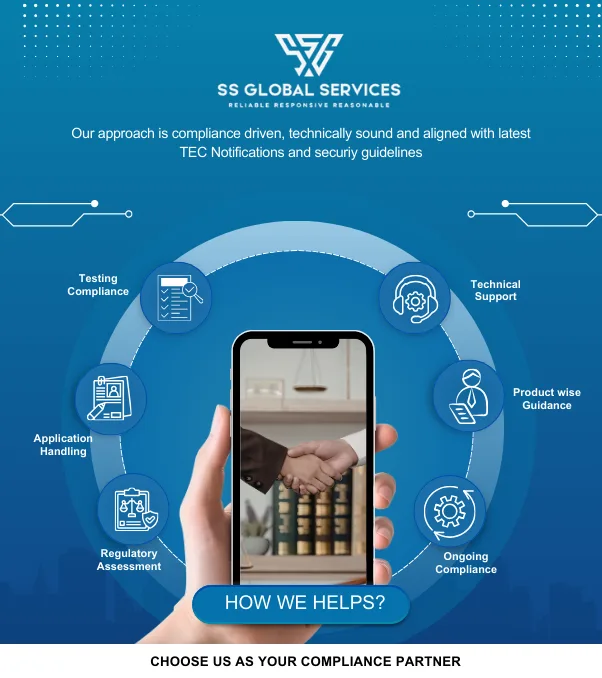
Our approach is compliance-driven, technically sound, and aligned with the latest TEC notifications, Essential Requirements (ERs), and ITSAR security guidelines.
- Regulatory Assessment & Applicability Check:
We begin by evaluating whether your telecom product falls under MTCTE Phase-1 to Phase-6. This ensures correct classification and avoids unnecessary testing or incorrect submissions.
- Complete MTCTE Application Handling:
From user registration on the MTCTE portal to final certificate issuance, we manage the entire application process, ensuring every step complies with TEC procedural requirements.
- Testing & ITSAR Compliance Coordination:
Our team coordinates with TEC-designated and NABL-accredited laboratories for EMI/EMC, safety, RF, and security testing, including ITSAR compliance where applicable.
- Technical Documentation Support:
We prepare and review technical files, declarations, test reports, and compliance statements as per TEC formats to minimize queries and rejection risks.
- Phase-wise & Product-wise Guidance:
Whether your product falls under routers, switches, base stations, IoT devices, or telecom infrastructure equipment, we provide clear guidance based on the applicable MTCTE phase and mandatory dates.
- Ongoing Compliance & Updates:
We keep you informed about changes in MTCTE scope, new product notifications, and security updates so your approvals remain valid and future-ready.
At SS Global Services, we act as a long-term TEC / MTCTE compliance partner, not just a certification agent. Our structured process reduces approval timelines, eliminates compliance gaps, and ensures your telecom products meet all technical, safety, and security requirements mandated in India.
With our expert support, businesses can confidently obtain TEC / MTCTE certification, avoid regulatory penalties, and successfully introduce telecom products into the Indian market.
Talk With TEC ExpertsFrequently Asked Questions (FAQs)
Our Top Services
At SS Global Services, we offer a complete range of certification and compliance services tailored to meet the needs of manufacturers, importers, and brand owners. From BIS and BEE certifications to EPR, WPC, TEC, and LMPC registrations, our expert-led process ensures fast approvals, minimal delays, and full legal compliance. Our top services are trusted by startups and global enterprises alike for their accuracy, reliability, and support at every step.
Get BEE Registration for appliances with expert support. Ensure energy label compliance in India.
Fast BIS CRS Registration for electronics. Ensure product quality, compliance.
Get EPR Registration for E-Waste in India. Fulfill CPCB norms & stay compliant with waste regulations.

Apply for Plastic Waste EPR Registration easily. Meet SPCB/CPCB norms and plastic recycling rules.
Comply with Battery Waste Management Rules. Get EPR Registration for lithium, lead, and used batteries.
Effortless EPR for End-of-Life Tyres. Ensure MoEFCC compliance and receive CPCB authorization.
Get WPC ETA Approval for wireless devices. Import legally and quickly meet India’s RF device norms.
Ensure compliance under the BIS Scheme-X Certification. Get expert guidance for product safety approvals.

Obtain TEC/MTCTE Approval for telecom products. Fast testing and certification under DoT norms.
Get TAC & IMEI Registration with our support. Ensure mobile device compliance with Indian telecom law.
Apply for EPR Authorization for Used Oil. Ensure environmentally compliant collection, recycling, and safe disposal
Request Service Today!
Ready to get certified or need expert compliance support? Fill out the form below and our team at SS Global Services will connect with you shortly.
We offer fast, reliable, and hassle-free assistance for all BIS and regulatory certification needs.