Introduction: Latest Wi-Fi CPE ITSAR Update in India
The Department of Telecommunications (DoT), through the National Centre for Communication Security (NCCS), has released a new update to the Indian Telecom Security Assurance Requirements (ITSAR) for Wi-Fi Customer Premises Equipment (Wi-Fi CPE). This latest update, identified as ITSAR402122512, introduces enhanced security guidelines under the MTCTE certification framework.
The update focuses on improving cybersecurity, data protection, and network reliability for Wi-Fi devices used across homes, enterprises, and service provider networks. Manufacturers and importers of Wi-Fi CPEs must now align their products with the revised requirements to continue selling in the Indian market.
With the growing use of Wi-Fi–enabled devices and increasing cybersecurity risks, this update plays a crucial role in strengthening India’s digital infrastructure. It ensures that Wi-Fi products meet strict security standards before reaching end users, helping prevent vulnerabilities, unauthorized access, and data misuse.
This update reflects the government’s continued efforts to enhance telecom security while promoting safe and trusted connectivity across the country.
View Official BIS Notification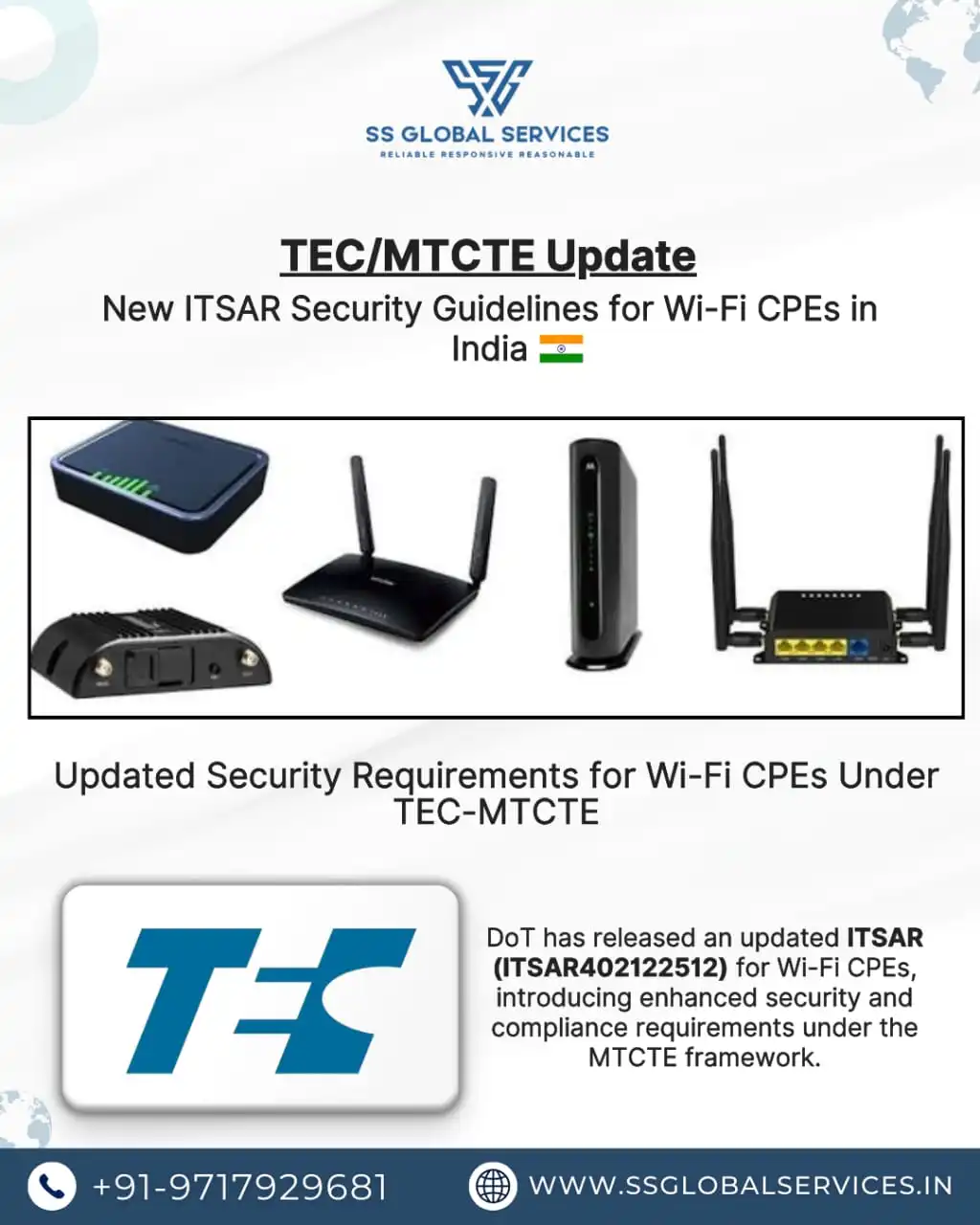
What Is Wi-Fi CPE and Why Is It Important?
Wi-Fi CPE (Customer Premises Equipment) refers to networking devices installed at the user’s location to provide wireless internet connectivity. These include Wi-Fi routers, access points, mesh systems, and cloud-managed devices commonly used in homes, offices, and enterprise environments.
Wi-Fi CPE plays a critical role in ensuring stable internet access and secure communication between users and service providers. Since these devices directly handle user data and network traffic, their security, reliability, and performance are essential for maintaining trusted connectivity.
With the rapid growth of connected devices and digital services, securing Wi-Fi CPEs has become a key priority for the Government of India. This is why such devices are now covered under ITSAR and MTCTE compliance, ensuring safer deployment and stronger cybersecurity across the country.
What Is the Latest ITSAR Update for Wi-Fi CPEs?
The Department of Telecommunications (DoT), through the National Centre for Communication Security (NCCS), has released an updated version of ITSAR for Wi-Fi CPEs (ITSAR402122512) under the MTCTE framework.
This update focuses on strengthening cybersecurity, device integrity, and data protection for Wi-Fi devices used across homes, enterprises, and service provider networks. The revised requirements reflect modern network architectures such as cloud-managed systems, controller-based access points, and advanced Wi-Fi technologies.
Compared to earlier versions, the updated ITSAR introduces more detailed security controls, particularly in areas such as authentication, software integrity, access management, and protection against cyber threats. The objective is to ensure that all Wi-Fi CPEs deployed in India meet consistent and high security standards.
This update applies to both newly launched products and existing models seeking MTCTE certification or renewal.
Government Notification: Updated ITSAR Security Requirements for Wi-Fi CPEs
Types of Wi-Fi CPE Covered Under This Update
The updated ITSAR applies to a wide range of Wi-Fi Customer Premises Equipment (Wi-Fi CPE) used in different deployment environments. These devices are commonly deployed across residential, enterprise, and service provider networks.
-
1. Integrated Wi-Fi CPE (Wi-Fi Routers)
Commonly used in homes and small offices, these devices provide basic internet access, LAN connectivity, and wireless networking.
-
2. Mesh Wi-Fi Systems
Mesh-enabled Wi-Fi CPEs allow multiple access points to work together, offering wider coverage and seamless connectivity.
-
3. Access Points with Controllers
Used mainly in enterprises and campus environments, these systems separate the control plane and data plane, enabling centralized management and enhanced security.
-
4. Cloud-Managed Wi-Fi CPE
These devices are managed remotely through cloud platforms, enabling centralized monitoring, configuration, and policy enforcement.
All these categories fall under the updated ITSAR scope and must comply with the defined security requirements before deployment in the Indian market.
Key Security Requirements Introduced Under the Updated ITSAR for Wi-Fi CPEs
The updated ITSAR introduces multiple security controls to protect Wi-Fi CPEs from cyber threats and unauthorized access. These requirements are designed to strengthen device security, data protection, and overall network reliability.
-
1. Access & Authentication Security
Secure authentication mechanisms are mandatory for device access, along with role-based access control (RBAC). Wi-Fi CPEs must also be protected against brute-force attacks and unauthorized login attempts.
-
2. Software & Firmware Security
Software and firmware updates must be securely managed, including protection against malware and unauthorized code. Devices should not contain unused or unsupported software components.
-
3. Data Protection & Encryption
Sensitive data must be protected using approved cryptographic algorithms. Wi-Fi CPEs should ensure secure data storage, transmission, and protection against data leakage or unauthorized access.
-
4. Network & Attack Protection
Devices must include safeguards against DDoS and network-level attacks, along with traffic filtering, anomaly detection, and secure handling of network interfaces and communication protocols.
These security requirements ensure that Wi-Fi CPEs remain resilient against evolving cyber threats and operate safely within India’s telecom networks.
Impact on Existing & Upcoming Wi-Fi Products
The updated ITSAR impacts both existing and upcoming Wi-Fi CPE models. Manufacturers may need to review their product architecture, firmware, and overall security design to ensure alignment with the revised requirements.
For existing products, re-testing or technical modifications may be required before certification renewal or continued deployment in the Indian market. In the case of upcoming products, compliance should be integrated at the design and development stage to avoid certification delays.
Failure to comply with the updated ITSAR requirements may result in approval delays or rejection under the MTCTE framework, potentially impacting product launch timelines and market access.
MTCTE Certification Requirements for Wi-Fi CPEs
Under the MTCTE framework, Wi-Fi CPEs must undergo security testing in accordance with the updated ITSAR guidelines before they can be sold or deployed in India. This ensures that devices meet national security and compliance standards.
Key requirements include:
- Mandatory compliance for both domestically manufactured and imported Wi-Fi CPEs
- Security testing through authorized telecom security testing laboratories
- Verification of security controls, software integrity, and data protection measures
Note: Only Wi-Fi CPEs that successfully meet all MTCTE and ITSAR requirements are granted certification for legal market access in India.
What Wi-Fi CPE Manufacturers Should Do Next
With the updated ITSAR now in effect, Wi-Fi CPE manufacturers should take timely action to ensure their products remain compliant with the latest security requirements. Early preparation not only reduces certification risks but also helps avoid unnecessary delays during the MTCTE approval process.
To stay aligned with the updated guidelines, manufacturers should focus on the following key steps:
- Review the updated security requirements carefully to understand new obligations under ITSAR
- Identify gaps in existing products, particularly related to security, authentication, and data protection
- Update firmware, software, and security controls wherever required to meet compliance standards
- Prepare complete technical documentation needed for MTCTE testing and evaluation
- Plan certification timelines in advance to avoid last-minute delays or approval issues
Taking these steps early allows manufacturers to streamline the certification process and reduce compliance-related risks. Proactive planning also ensures smoother market entry and long-term alignment with India’s evolving telecom security framework.
How SS Global Services Helps with Wi-Fi CPE Certification
SS Global Services offers complete end-to-end support for Wi-Fi CPE certification under the MTCTE framework, helping manufacturers navigate complex regulatory requirements with confidence. With years of experience in telecom compliance and certification, our team ensures that your products meet the latest ITSAR security requirements without unnecessary delays or rework.
We work closely with manufacturers, importers, and brand owners to simplify the certification process and ensure smooth coordination at every stage — from initial assessment to final approval.
Our support includes:
- ITSAR requirement analysis
- Technical documentation support
- Coordination with authorized testing laboratories
- End-to-end certification assistance
With deep regulatory expertise, SS Global Services helps manufacturers achieve faster approvals and full compliance with Indian telecom regulations.
Conclusion
The updated ITSAR for Wi-Fi CPEs marks an important step in strengthening India’s telecom security ecosystem. By aligning with these new requirements, manufacturers can ensure safer products, regulatory compliance, and long-term market sustainability.
Staying updated and preparing early is the key to a smooth certification under the MTCTE framework.
As regulatory expectations continue to evolve, timely compliance not only helps avoid approval delays but also builds trust with customers and stakeholders. Manufacturers that act early can gain a competitive advantage while ensuring their products meet India’s growing security and quality standards.
Frequently Asked Questions (FAQs)
Request Service Today!
Ready to get certified or need expert compliance support? Fill out the form below and our team at SS Global Services will connect with you shortly.
We offer fast, reliable, and hassle-free assistance for all BIS and regulatory certification needs.