Overview: NCCS ITSAR IP Router (Version 2.0.0)
The National Centre for Communication Security (NCCS) has released an updated Indian Telecom Security Assurance Requirements (ITSAR) notification for IP Routers, bringing significant changes to India’s telecom security compliance landscape. Issued under the MTCTE framework, this latest ITSAR Version 2.0.0 (December 2025) replaces earlier versions and introduces stronger, more comprehensive security controls for modern IP router deployments.
ITSAR (Indian Telecom Security Assurance Requirements) is a mandatory security standard issued by NCCS under the Department of Telecommunications (DoT). It defines country-specific cybersecurity requirements that telecom equipment must meet before being deployed in Indian networks.
For IP Routers, ITSAR ensures that the equipment used in telecom, ISP, enterprise, and government networks is free from security risks such as backdoors, weak authentication, insecure software, or unauthorized data leakage.
Under the MTCTE (Mandatory Testing and Certification of Telecom Equipment) framework, IP routers must comply with ITSAR requirements in addition to technical standards.
View Official Notification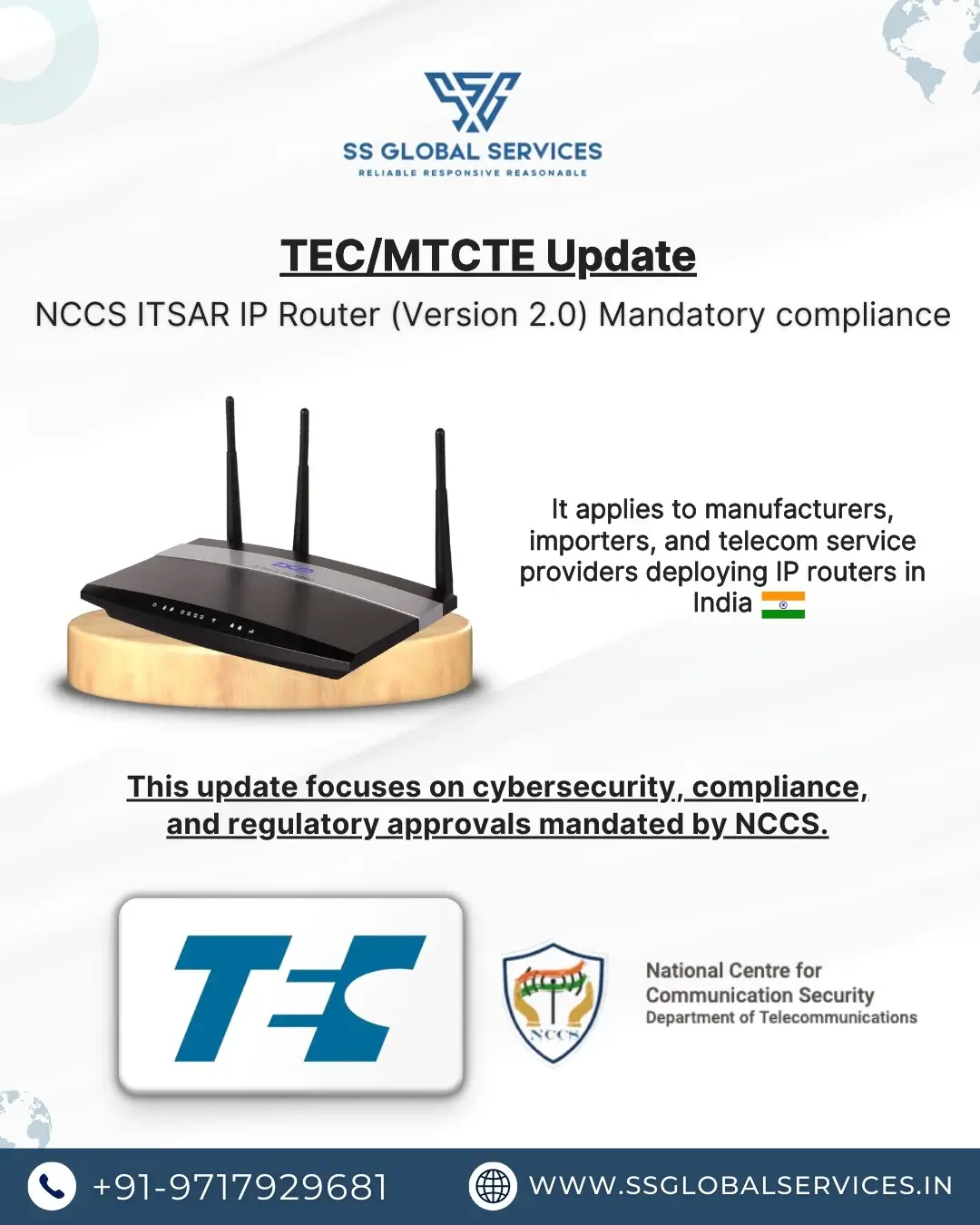
What is ITSAR and Why It Matters for IP Routers?
ITSAR (Indian Telecom Security Assurance Requirements) is a mandatory cybersecurity framework issued by NCCS under the National Centre for Communication Security (NCCS) Its primary purpose is to ensure that telecom equipment used in India is secure, trustworthy, and resilient against cyber risks.
IP Routers play a critical role in telecom and data networks. They manage data traffic, connect networks, and enable communication across enterprises, service providers, and government systems. Because of this central role, any weakness in an IP router can lead to data breaches, service outages, or even national security risks.
ITSAR ensures that IP routers:
- Follow strict cybersecurity standards
- Prevent unauthorized access and misuse
- Protect sensitive data and communication channels
- Meet India’s national security expectations
Under the MTCTE certification framework, compliance with ITSAR is mandatory before any IP router can be deployed or sold in the Indian market.
What’s New in ITSAR IP Router (Version 2.0.0)
The ITSAR Version 2.0 update reflects the growing complexity of modern networks. Unlike earlier versions, this update goes beyond traditional hardware-based routers and now includes advanced technologies such as cloud, virtualization, and software-defined networking.
Key improvements include:
- Expanded coverage for SDN, VNF, and cloud-native routers.
- Stronger access control and authentication mechanisms
- Enhanced protection against cyber threats and data exfiltration
- Improved requirements for secure software updates and system integrity
- Mandatory logging, auditing, and vulnerability assessment
These enhancements ensure that IP routers deployed in India can withstand modern cybersecurity challenges while maintaining operational reliability.
Get Compliance SupportApplicability of ITSAR for IP Routers
● Products covered under this notification:
- Conventional Routers
- SDN Routers
- Cloud-Native Routers
- Virtual Routers
- Cloud-Managed Routers
● Applicable deployment scenarios:
- Core Networks
- Edge Networks
- Access Networks
- Data Centers
- ISP & Telecom Infrastructure
● Applicability to IPv4 and IPv6 environments
Types of IP Routers Covered Under ITSAR (Version 2.0)
- 1. Conventional Routers
Traditional hardware-based routers used in telecom and enterprise networks with integrated control and forwarding planes.
- 2. SDN (Software Defined Network) Routers
Routers where control and data planes are separated, allowing centralized management and flexible traffic control.
- 3. Cloud-Native Routers
Software-based routers deployed in cloud-native environments using containers and microservices.
- 4. Virtual Routers (VNF)
Routers deployed as virtual network functions on standard computing infrastructure.
- 5. Cloud-Managed Routers
Routers managed through centralized cloud-based platforms for configuration, monitoring, and updates.
Official Notification – ITSAR IP Router (Version 2.0)
Issued by the National Centre for Communication Security (NCCS), Ministry of Communications, Government of India..
Key Security Requirements Under ITSAR IP Router
The ITSAR framework defines essential security controls that IP routers must follow to ensure safe and reliable network operations.
- 1. Access Control & Authentication
IP routers must use role-based access control (RBAC) and secure authentication methods. Access to critical systems should be limited to authorized users only, with proper control over remote and privileged logins.
- 2. Password & Account Management
Strong password policies are mandatory, including password complexity, expiry, and account lockout after failed attempts. Default credentials must be removed to prevent unauthorized access.
- 3. Secure Software & Firmware Management
All software and firmware updates must be securely signed and verified before installation. This ensures protection against malware, unauthorized modifications, and hidden backdoors.
- 4. Network & Interface Security
Management interfaces must be securely configured, and unnecessary services should be disabled. Routers must prevent unauthorized access and protect against malicious network activity.
- 5. Audit Logs & Monitoring
Routers must generate secure logs for system activity, configuration changes, and access events. These logs help in monitoring, auditing, and identifying security incidents.
- 6. Cryptographic & Data Protection
Sensitive data must be protected using approved cryptographic methods to ensure secure storage and transmission, preventing data leakage or tampering.
Who Needs to Comply With ITSAR for IP Routers?
ITSAR compliance is mandatory for all entities involved in the deployment or distribution of IP routers in India, including:
- Manufacturers producing IP routers
- Importers bringing networking equipment into India
- OEMs supplying branded networking products
- Telecom operators and internet service providers
- System integrators deploying network infrastructure
Any organization planning to use or sell IP routers in India must meet these requirements before deployment.
Get Service NowWhy NCCS Introduced Updated ITSAR Requirements for IP Routers
IP routers form the backbone of telecom and internet infrastructure. Any vulnerability in routers can lead to:
- Network outages
- Data breaches
- National security risks
- Unauthorized surveillance or traffic manipulation
With increasing adoption of cloud, virtualization, and 5G networks, NCCS introduced updated ITSAR requirements to ensure:
- Secure and trusted telecom infrastructure
- Prevention of cyber espionage and hidden backdoors
- Alignment with global cybersecurity standards
- Long-term resilience of India’s digital networks
MTCTE Certification Process for IP Routers
To achieve certification under MTCTE, organizations must follow a structured compliance process. This typically includes:
- Identifying applicable ITSAR requirements
- Performing a security gap analysis
- Implementing necessary security controls
- Conducting testing at a TEC-designated laboratory
- Submitting documentation and compliance reports
- Receiving approval under the MTCTE framework
Early planning and proper documentation can significantly reduce approval timelines and avoid last-minute challenges.
Benefits of ITSAR-Compliant IP Routers
Complying with ITSAR offers multiple long-term advantages, including:
- Stronger cybersecurity protection
- Higher trust among telecom operators and enterprises
- Faster regulatory approvals
- Improved acceptance in government and enterprise projects
- Reduced operational and compliance risks
How SS Global Services Helps with ITSAR & TEC/MTCTE Compliance for IP Routers
At SS Global Services, we provide end-to-end support for ITSAR IP Router compliance under the MTCTE framework. Our approach is practical, structured, and aligned with NCCS and TEC requirements.
- Applicability Assessment & Gap Analysis:
We evaluate whether your IP Router falls under ITSAR requirements and identify compliance gaps based on the latest NCCS guidelines.
- Documentation & Compliance Preparation:
We assist in preparing all required technical documents, declarations, and compliance records as per MTCTE and ITSAR norms
- Coordination with TEC-Designated Labs (TSTL):
Our team coordinates with authorized testing laboratories to ensure smooth testing, validation, and resolution of observations.
- End-to-End Certification Support:
From initial assessment to final MTCTE approval, we manage the complete certification process to help avoid delays and rework.
- Regulatory Guidance & Ongoing Support:
We provide continuous support throughout the certification lifecycle, helping you stay aligned with evolving regulatory requirements.
With more than a decade of experience in telecom compliance and certification services, SS Global Services helps businesses achieve smooth, accurate, and timely ITSAR compliance without unnecessary complexity.
Get Service NowConclusion
The ITSAR IP Router (Version 2.0) update is a major step toward strengthening India’s telecom security framework. As networks become more complex and interconnected, compliance is no longer optional—it is essential.
Organizations that prepare early and align with ITSAR requirements can ensure smoother approvals, stronger security, and long-term success in the Indian telecom market.
For expert guidance and end-to-end MTCTE compliance support, SS Global Services is here to help.
Frequently Asked Questions (FAQs)
Request Service Today!
Ready to get certified or need expert compliance support? Fill out the form below and our team at SS Global Services will connect with you shortly.
We offer fast, reliable, and hassle-free assistance for all BIS and regulatory certification needs.